The Codex
All modifiers and their effects.
Your bishops can swap places with one of your pieces standing in their line of sight.
Your pawns can jump over the piece directly in front of them, and capture on the landing square.
Your pawns promote from your 6th rank onwards.
While one of your knights threatens the enemy king, it cannot be captured.

Your rooks can pass through your other pieces.

Your pawns permanently transform into the first piece they capture.
Your bishops can bounce off the edges of the board and continue their diagonal move along the perpendicular diagonal (thus staying on squares of the same colour).
As soon as you take this card, choose one of your pawns: it now moves like a queen and loses its pawn properties. You lose all your other pawns.
Every time you capture a pair of your opponent's pieces (pawns excluded), or their queen, you choose one of their pawns, which is captured.
If you manage to draw the game, whatever the cause, you win. As soon as you take this card, capture an enemy pawn of your choice.
One of your pawns orthogonally adjacent to another can move like a rook along the axis they form (this counts as a move).
Your pawns advance 2 squares (3 from their starting square). They can be captured en passant on each of these moves.
Your king can also move 2 squares per turn, optionally changing direction. It must not be put in check along the way and cannot capture on the intermediate square.
Your pawns can also move one square diagonally forward.
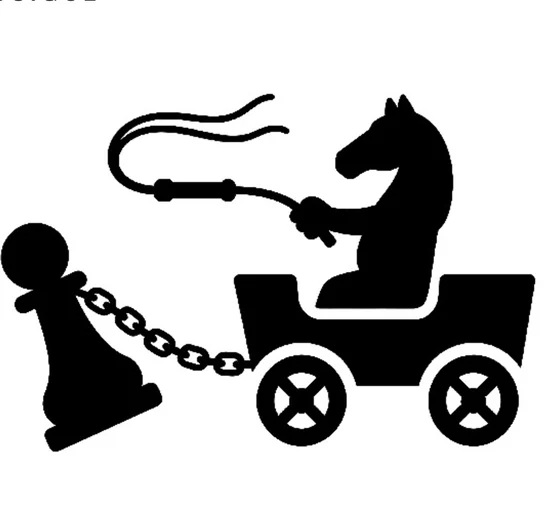
When you move a pawn forward, you may also move a piece that was orthogonally adjacent to it the same number of squares forward.
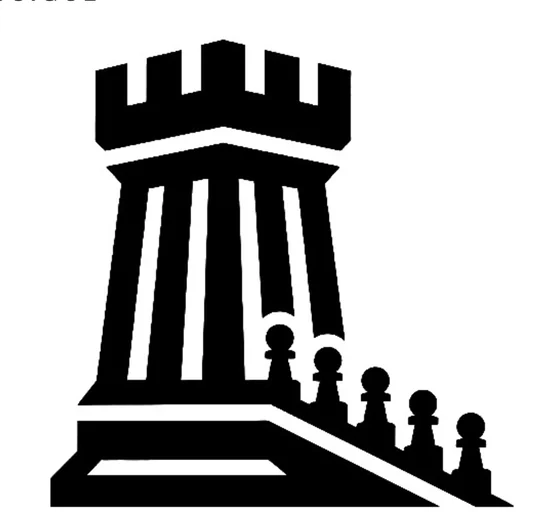
One of your pawns orthogonally adjacent to one of your rooks can climb on top of it. The rook moves normally, carrying the pawn along. The pawn can climb down onto an unoccupied orthogonally adjacent square. Each of these actions counts as a move.
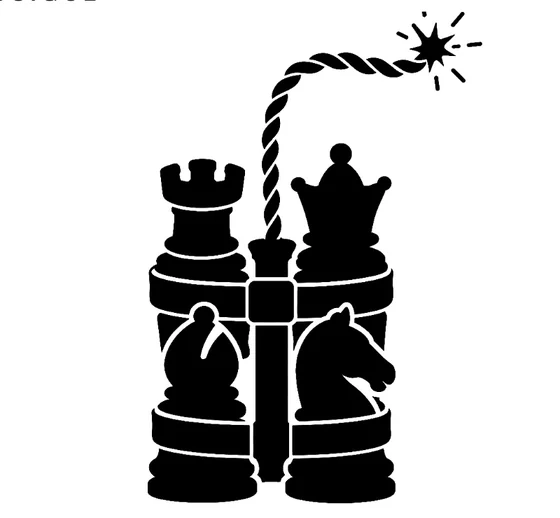
All your pieces (king excluded) can sacrifice themselves, capturing every piece they threaten (this counts as a move).

When one of your knights moves over an enemy piece, it captures it (the orthogonally adjacent square in the direction of the first 2 squares of the L). If it can capture the enemy king this way, that king is put in check.

Your knights can also move 3 squares in a straight line; they can jump over pieces during these moves.
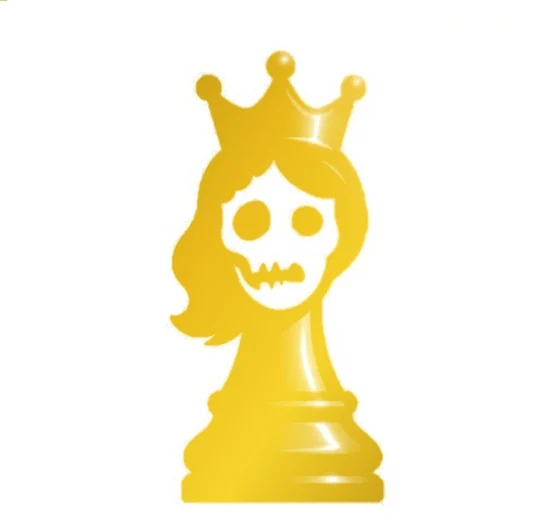
When your queen is captured for the first time, you may put her back on any unoccupied square of your first rank on the turn of your choice (this counts as a move). She can then only move up to 3 squares away (diagonals or straight lines).

Your pawns can also capture one square straight ahead.

At the end of their diagonal move, your bishops can move one extra square along a perpendicular diagonal, if they did not capture a piece on the first move.

Your bishops can also move like a king.
When a pair of your pieces (pawns excluded) is captured, you may put one of them back on any unoccupied square of your first rank on the turn of your choice (this counts as a move). It can then only move up to 3 squares away. The zombie knight can no longer jump over pieces orthogonally adjacent to it.

Your pawns can also capture backwards the same way they capture forwards.

If one of your rooks moves onto a square occupied by one of your bishops (or the other way round), you may merge the two pieces: remove the bishop and turn your rook into a queen.

Your bishops can teleport to any unoccupied square of the same colour as the square they stand on (this counts as a move).
Your king can bring any one of your pieces to an unoccupied square adjacent to it (lines and diagonals). This counts as a move.
Your captured pawns reappear on your first rank, in the file where they were captured, as soon as that square is unoccupied at the end of your turn. They can only move 2 squares from your 2nd rank.

The enemy king is sent back to its starting square. If a piece is there, they swap. It can no longer castle. You can castle as many times as you like, from any square, even while in check. This is possible as long as the castling destination squares are neither occupied nor under attack.
If your knights reach the last rank of the board, they may be promoted to queen.
Your rooks can also move like a king.
If at the end of 5 consecutive turns of yours you have strictly more pieces than your opponent in the central square (the 4 central squares), you win the game.
Your rooks can pull a piece (friendly or enemy) standing in their line of sight to the square orthogonally adjacent to them (this counts as a move).

Your pawns can also perform "en passant" captures on every enemy piece except knights.

Your pawns can also capture 2 squares diagonally forward if the line of sight is clear.
Your pieces (pawns and king excluded) standing on the central square (the 4 central squares) can also move like a queen while they remain there.

If you check the enemy king 8 times, you win the game (double checks count twice).

If 2 of your pieces are adjacent on the same rank, they protect each other. If an enemy piece captures one of them, the other may, on the following turn, recapture it by moving to the square where the capture took place, even if its normal move would not allow it (this counts as a move).

Your knights can also move in an "L" of 3 + 1 squares (3 squares in one direction and 1 square perpendicular).

If your pieces can reach the side edges of the board, they can continue their move from the opposite edge, as if the board were a cylinder.

Your pawns can also capture one square straight ahead and move one square diagonally forward.

Your queens can also move like a knight.

All your pieces can pass through your other pieces.
Your bishops can also move like knights.

Your knights can also move like a king.

You lose your queen. Your knights, bishops and rooks can also move like a king.

Your pieces (pawns and king excluded) adjacent (lines and diagonals) to your rooks can also move like a rook.